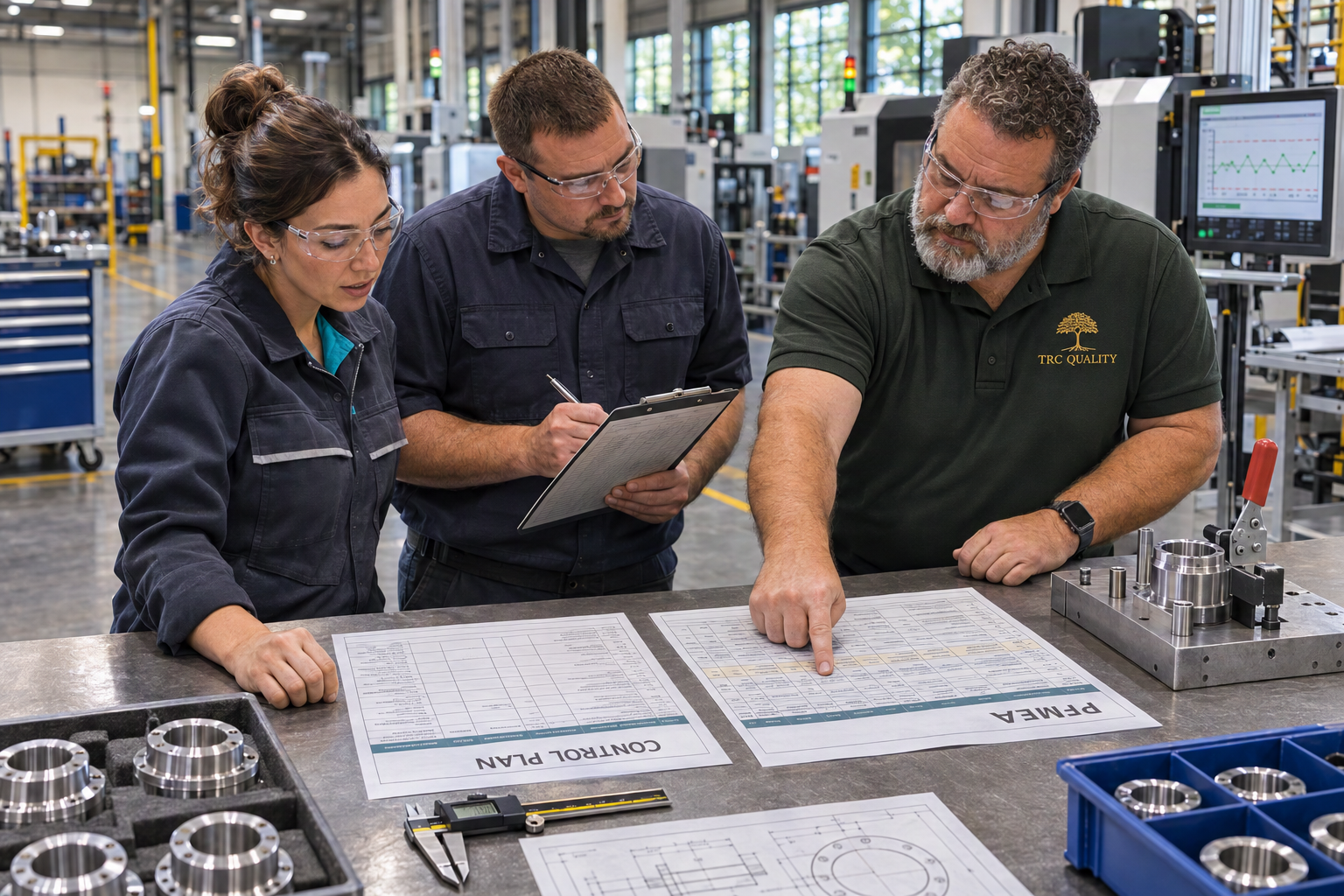
PFMEA, Control Plan and Work Instruction Alignment
Aligning Process Risk, Controls, and Shop-Floor Execution
When the Process Changes, the Documentation Must Change With It
Manufacturing processes rarely remain exactly as originally designed. Processes drift over time.
Equipment changes. Tooling changes. Suppliers change. Materials change. Operators develop different methods. Controls are added or removed. Measurement methods change. New failure modes emerge.
The problem begins when the Process Flow, PFMEA, Control Plan, Work Instructions, and actual manufacturing process do not change together.
TRC evaluates the complete chain from process flow → risk → prevention → detection → control → reaction → shop-floor execution, identifying where documented requirements and actual manufacturing practices have separated.
The objective is not simply to update documents.
The objective is to make sure the risks identified in the PFMEA are actually controlled in production and that the controls being used on the manufacturing floor address the risks that exist today.
The Documents Should Describe One Process
The Process Flow Diagram, PFMEA, Control Plan, Work Instructions, measurement methods, reaction plans, and actual manufacturing operation should describe one connected process.
TRC evaluates whether:
Process Flow steps match the actual manufacturing sequence
PFMEA failure modes represent genuine process risks
Failure causes describe meaningful sources of failure
Prevention controls address identified causes
Detection controls can identify failures before escape
Control Plan characteristics correspond with PFMEA risks
Measurement methods are capable and appropriate
Sampling frequencies reflect the process and risk
Reaction plans clearly define what happens when control is lost
Work Instructions implement the required controls
Operators can reasonably execute the documented requirements
Shop-floor practices match the documented process
A technically complete PFMEA provides limited protection if the controls identified in it are not implemented where the work actually occurs.
Prevention and Detection Are Not the Same
A strong control strategy distinguishes between preventing a failure and detecting one after it has occurred.
TRC examines whether controls actually perform the function assigned to them.
A prevention control should reduce the likelihood that the cause will occur.
A detection control should provide a meaningful opportunity to identify the condition before defective product progresses or reaches the customer.
Simply listing inspection as a control does not establish that the process is adequately controlled.
TRC evaluates the relationship among:
Risk → Cause → Prevention → Detection → Reaction
This helps identify situations where significant risks depend too heavily on inspection, where detection occurs too late, or where the documented control does not meaningfully address the identified cause.
When the Shop Floor and Documents Disagree
One of the most important parts of an alignment review is comparing documentation with the actual manufacturing process.
TRC does not evaluate PFMEAs and Control Plans only from a conference room.
The review can include direct observation of:
Actual process sequence
Equipment and tooling
Operator methods
Inspection and measurement activities
Process settings and parameters
Special characteristics
Error-proofing
Material identification and handling
Reaction to abnormal conditions
Rework and repair
Records and data collection
When actual practice differs from the documented process, the objective is not automatically to force the operator back to the document.
First determine why the difference exists.
The process may have drifted away from an effective requirement, or the documented requirement may no longer accurately represent the best way to perform the work.
Understanding that difference determines what should change.
Reaction Plans Must Work When the Process Doesn't
Controls are incomplete without an effective response when the process becomes abnormal.
TRC evaluates whether reaction plans clearly establish:
What condition triggers action
Who has authority to stop or contain the process
What product must be controlled
How suspect material is identified
What verification is required
When production may resume
Who must be notified
What records are maintained
When escalation or corrective action is required
A reaction plan should support a controlled response when something goes wrong, not require the organization to invent the response after the problem occurs.
Corrective Action and Lessons Learned Must Flow Back Into the System
A recurring defect, quality escape, customer complaint, supplier issue, or corrective action should create learning.
TRC evaluates whether that learning is incorporated into the appropriate:
Process Flow
PFMEA
Control Plan
Work Instruction
Measurement method
Reaction plan
Training
Similar products or processes
If the organization solves a problem but the underlying risk analysis and control strategy remain unchanged, the same weakness may remain elsewhere.
Lessons learned should strengthen the system, not remain trapped in a corrective-action report.
Supplier PFMEA and Control Plan Reviews
The same principles apply to supplier manufacturing processes.
A supplier may submit a complete PPAP package while actual production has changed or while the PFMEA and Control Plan provide limited protection against important manufacturing risks.
TRC can evaluate supplier:
Process Flow Diagrams
PFMEAs
Control Plans
Work Instructions
Measurement methods
Process capability
Special-characteristic controls
Reaction plans
Shop-floor execution
Corrective-action integration
PPAP and launch readiness
The objective is not simply document approval.
The objective is confidence that the supplier understands its manufacturing risks and has effective controls operating where the product is actually made.
The Outcome
TRC helps reconnect process risk, manufacturing controls, documentation, and execution.
The result is:
Better alignment between the PFMEA and actual process risk
Stronger prevention and detection controls
Control Plans that reflect actual manufacturing
Work Instructions that implement the control strategy
Clearer reaction plans
Better integration of lessons learned
Reduced opportunity for process drift
Greater confidence that documented controls exist on the manufacturing floor
The objective is simple: the process you analyze, the process you document, and the process you actually operate should be the same process.
Related TRC Services
PFMEA and Control Plan gaps often reveal broader weaknesses in supplier capability, corrective action, measurement, or the quality management system. When the evidence leads beyond document alignment, related TRC services include:
Supplier Capability Assessment
Evaluate whether supplier processes, controls, measurement systems, and management practices are capable of consistently meeting requirements.
Root Cause Analysis & Corrective Action
Investigate recurring defects and quality escapes to determine why the failure occurred, why existing controls did not detect it, and what system conditions allowed the weakness to persist.
Quality Systems Assessment, Alignment & Improvement
Evaluate whether process ownership, risk management, controls, measurement, and actual operating practices work together as an effective management system.
Find the Gaps Before They Become Customer Problems
TRC can review an existing PFMEA and Control Plan, evaluate alignment on the manufacturing floor, or help rebuild the complete connection between Process Flow, PFMEA, Control Plan, Work Instructions, measurement, reaction plans, and actual production.